Workforce Intelligence
Continuously monitor emerging technologies, labor-market trends, and evolving skill requirements so regional leaders can invest based on real-time employer demand.
White Paper · 2026
It is the wrong question.
Disruption is not arriving job by job. It is arriving system by system — across hiring, training, credentialing, and regional economies. The IWI Framework™ gives leaders a structural way to prepare.
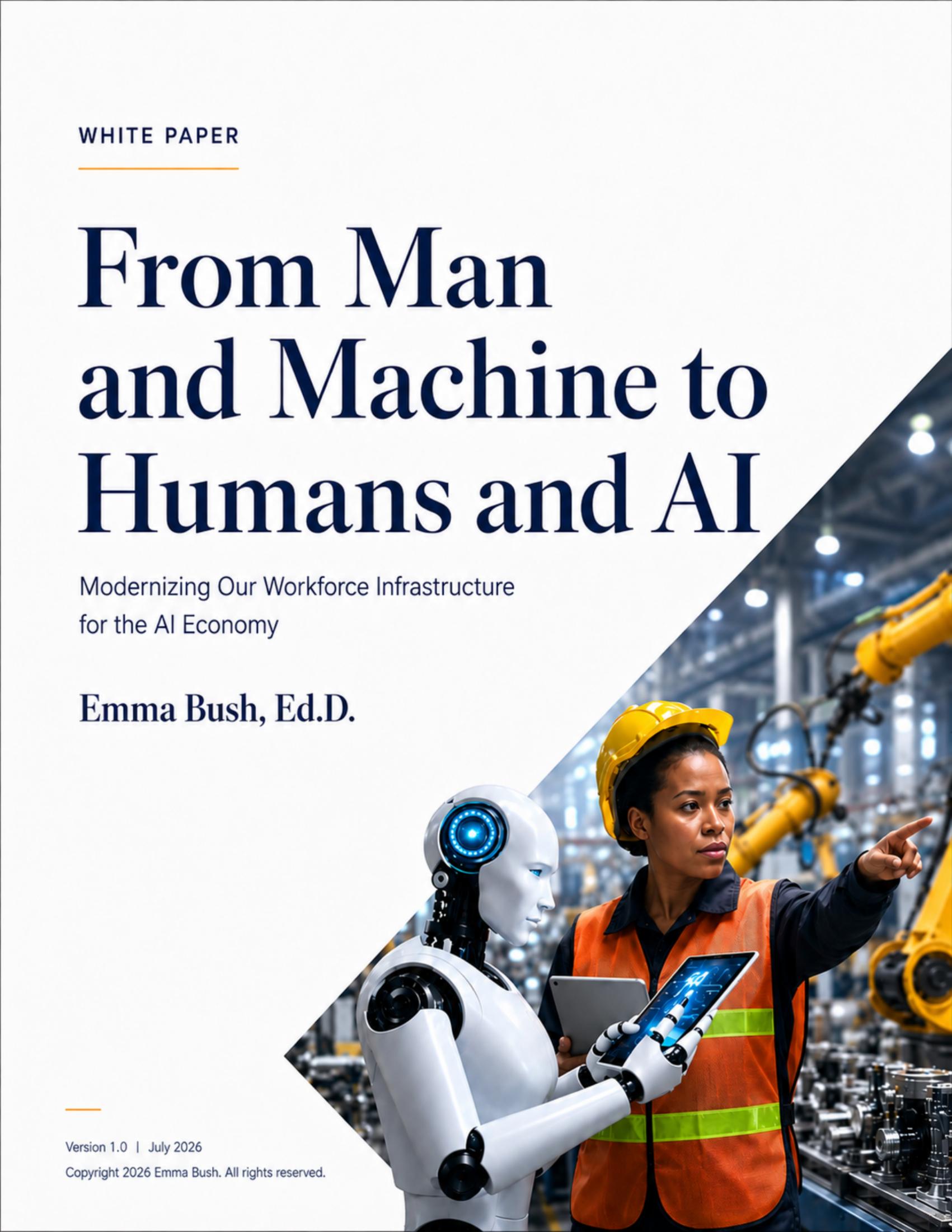
We spend enormous energy asking which occupations AI will eliminate, automate, or disrupt. That question is too narrow. The more consequential question is whether our workforce infrastructure is ready to keep pace with the new skills, functions, and opportunities the AI Economy is creating.
The next century of work will be defined by the partnership between Humans and AI. This paper examines that transition and presents the Integrated Workforce Infrastructure Framework™ — a systems approach for modernizing regional talent architecture.
Drawing on practice across workforce boards, community colleges, employers, and economic development organizations, it offers a coherent architecture for talent strategy, employer engagement, and regional resilience.
The IWI Framework™
Integrated Workforce Infrastructure
Real-time labor-market insight
Boards as regional conveners
Modernized career & employer services
Colleges as talent engines
One coordinated regional talent ecosystem
The future of work is not simply about AI replacing people. It is about how humans and AI will work together—and whether our workforce, education, talent, and economic systems can evolve quickly enough to support that transformation.
Previous technological revolutions changed how people worked and the tools they used.
Artificial intelligence is changing the relationship between people, technology, and work itself.
We need to modernize and better connect the extraordinary workforce infrastructure we already have—and align it with the realities of the AI Economy.
A field-tested architecture that connects the workforce system's strongest assets into a coordinated regional talent ecosystem.
Continuously monitor emerging technologies, labor-market trends, and evolving skill requirements so regional leaders can invest based on real-time employer demand.
Position Local Workforce Boards as regional conveners aligning employers, education, and economic development around shared workforce priorities.
Modernize American Job Centers into proactive solution hubs — career navigation, customized employer services, apprenticeships, and work-based learning.
Position community colleges as the collaborative engine, translating employer demand into customized training, short-term credentials, and industry-aligned pathways.
Understanding the billions already invested in our workforce infrastructure.
ExploreWhy LWDBs and AJCs must lead the transition in the AI Economy.
ExploreBuilding an integrated workforce ecosystem that works for people and employers.
ExploreUsing labor market intelligence to drive real-time decisions and better outcomes.
ExplorePartnering with business to create opportunity at scale.
ExplorePreparing people for the future of work in a Human-AI world.
ExploreRegional conveners aligning talent strategy.
Frontline access points for workers and employers.
Anchors of regional talent and credentialing.
Architects of regional competitiveness.
Designers of work, roles, and career pathways.
Stewards of policy, funding, and systems.
Shapers of the rules that govern the future of work.
Practitioners advancing the field.

Workforce Strategist · Researcher · Executive Advisor
Dr. Bush is a workforce systems strategist specializing in regional talent ecosystems, workforce infrastructure, and Human-AI workforce transformation.
She has led registered apprenticeship initiatives, regional partnerships across employers and education, and large-scale transformation efforts inside workforce systems. Her current research focuses on the infrastructure regions need to compete in the next economy.
Through her writing, advisory work, and The Workforce Infrastructure Playbook™, she advances a systems approach to building durable, equitable, and resilient regional workforces.
The implementation companion to the IWI Framework™. It translates the Framework into practical tools, roadmaps, and templates that move regions and institutions from strategy to execution.
Request early accessFor workshops, speaking engagements, technical assistance, workforce transformation initiatives, or consulting inquiries.